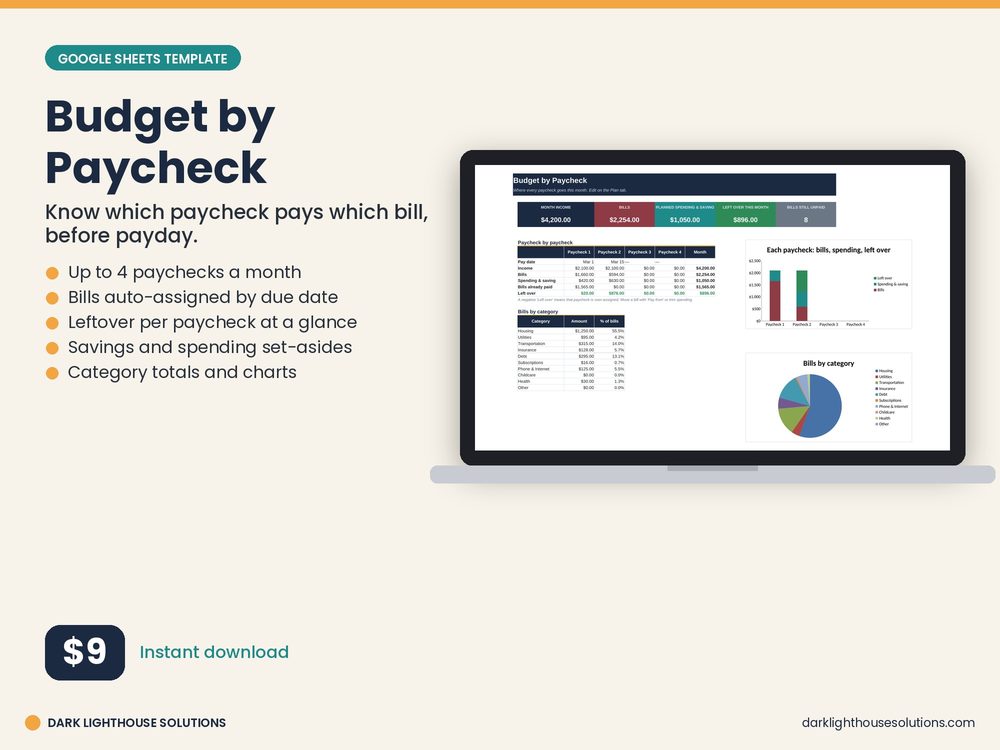
Budget by Paycheck
Add your paychecks and bills. It assigns each bill to the right paycheck and shows what's left from each one.
$9Buy now
Free tools › Budget by paycheck calculator
Enter your paydays and your bills with their due dates. See which paycheck covers each bill, what's left from every check, and how to fix a paycheck that comes up short. Free, no sign-up.
Budget by Paycheck does the same assignment in Google Sheets, tracks what's paid and carries leftovers forward. The bundle adds Debt Payoff, Sinking Funds and two more.
Add your paychecks and bills. It assigns each bill to the right paycheck and shows what's left from each one.
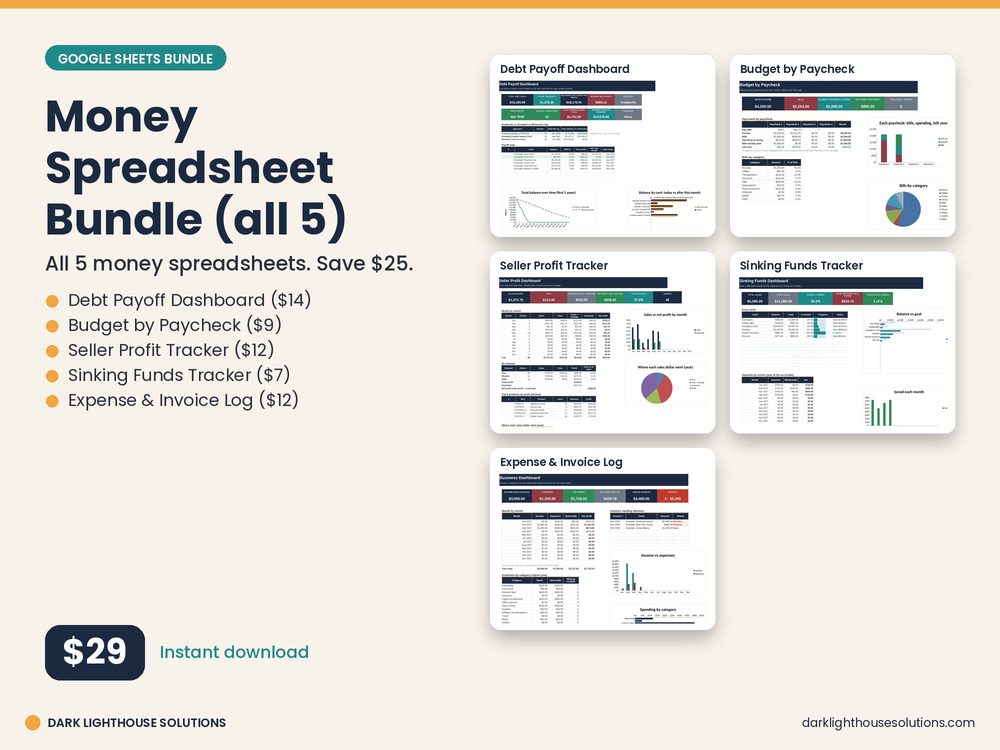
Debt Payoff Dashboard, Budget by Paycheck, Sinking Funds, Seller Profit Tracker and Expense & Invoice Log. $54 bought separately.
A monthly budget says you earn $3,200 and spend $2,900, so you're fine. Then rent, the car payment and insurance all land in the first week, and you're not fine. Budgeting by paycheck fixes that by planning money in the order it actually arrives.
Each card is one paycheck: the date, which bills it pays and their due dates, and what's left over. A red card means that check can't cover its bills. When that happens, the calculator looks for bills it can pay earlier from a check that has room. It never moves a bill later, so nothing will be late. You'll see the suggested changes and a balanced version of the plan.
If you're paid every week or every two weeks, switch the plan to 2 or 3 months. You'll see why some checks feel bigger than others, and you'll spot the months with an extra paycheck coming.
The "left" number on each card isn't extra money. It's what you have for everything that isn't a bill: eating out, gifts, the kids' school things, the random Target run. If one check leaves $600 and the next leaves $90, plan your bigger spending around the $600 week, and keep the $90 week quiet. When every check has a positive number, you can start pointing some of it at a sinking fund or extra debt payments.
Want this to run every month without re-entering anything? The Budget by Paycheck spreadsheet below does the same assignment in Google Sheets. It tracks what's paid and carries leftover money forward, so each check has a plan before it lands.
Instead of one monthly budget, you plan each paycheck on its own: which bills it pays, what goes to savings, and what's left to spend until the next payday. It's the easiest way to stop the 'rent week' crunch, when one check has to cover almost everything.
The usual rule, and the one this calculator uses, is that each bill is paid from the last paycheck that arrives on or before its due date. A bill due on the 1st is paid from the check you get at the end of the month before. If you want a cushion, set 'pay bills early' to 2 or 3 days.
The calculator flags it and suggests moving one or more bills to an earlier paycheck that has room left. Paying early is always allowed, so that's often enough to balance it. If it isn't, many companies will change a due date if you call and ask, which is often the easiest permanent fix.
If you're paid every week or every two weeks, a few months a year have an extra paycheck. Set the plan to 2 or 3 months to see them. Because your monthly bills are already covered, an extra check is a great time to build savings or pay down debt.
It uses the dates you enter. Many employers pay on the Friday before a weekend or holiday payday. If yours does, use that date. Paying a bill a day or two early never hurts.