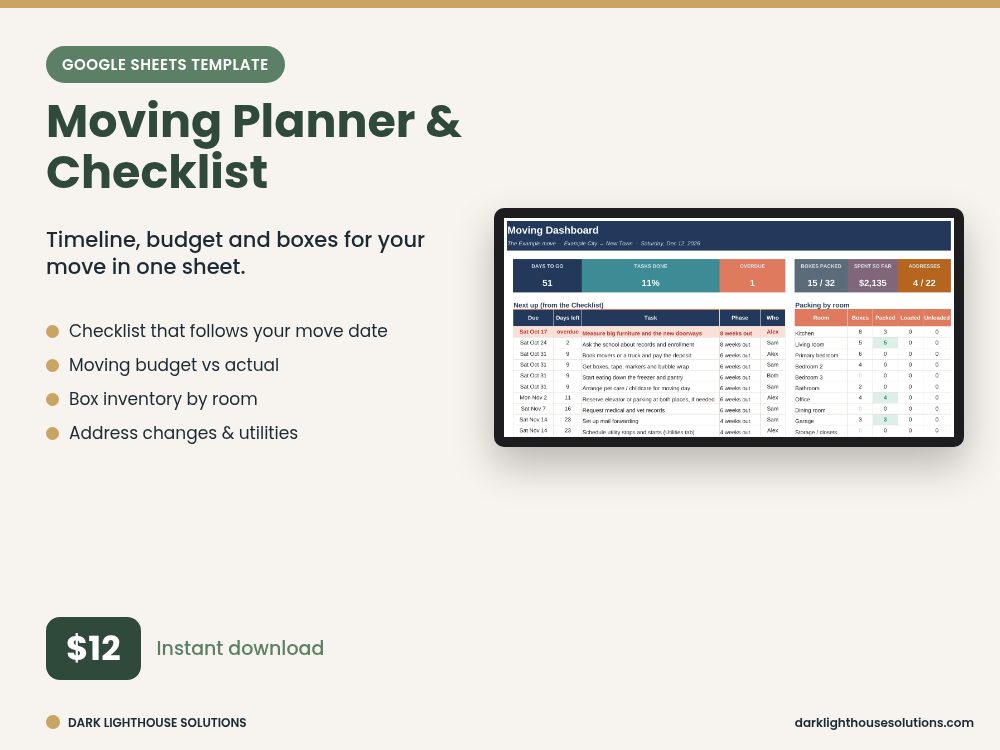
Moving Planner & Checklist
Timeline, budget, box inventory, address changes and utilities for a move, in one spreadsheet.
$12Buy now
Free tools › Moving cost calculator
List what your move will cost and when each payment hits. Get your total, the cash you need by move day, and how much to set aside each week. Free, no sign-up, no email, and nothing leaves your browser.
The Moving Planner has the week-by-week checklist, this budget, a box inventory and every address and utility to change, in one Google Sheet.
Timeline, budget, box inventory, address changes and utilities for a move, in one spreadsheet.
Most people budget for the truck or the movers and forget the rest. The bigger costs often come from the new place, and they land weeks before the move. A realistic moving budget has four parts:
A $5,000 move is hard enough. A $5,000 move where $3,000 is due four weeks out is a different problem. This calculator puts every cost on a date based on your move day, adds a running total, and shows how much cash you need on hand by each point. If something is already due, it shows "now" so it doesn't fall off the plan.
A quick example: the sample costs above add up to $5,320, plus a 10% buffer, for $5,852. If the move is six weeks away, about $5,250 of that is due by move day, and $1,700 of it (the deposit and the movers' booking fee) is due in week two. That early chunk is why the weekly amount comes out higher than $5,852 ÷ 6.
It also works out a steady amount to put aside every week from today. That's usually the easiest way to cover a move without putting it on a credit card. If the weekly number is too high, you have three levers: push the move date back, cut or delay the setup costs (most furniture can wait a month), or get a cheaper quote on the move itself.
The Moving Planner below keeps all of this in one Google Sheet: the week-by-week checklist, the budget, a box inventory, and every address and utility you need to change.
It depends mostly on distance, how much stuff you have and whether you hire movers. A local DIY move with a rental truck and friends can be a few hundred dollars. A long-distance move with full-service movers can cost thousands. The move itself is often the smaller part, though. Deposits, first month's rent and setting up the new place are what catch people out, so this calculator includes them.
No. They're placeholders so you can see how the calculator works, and they're labeled as examples. Replace each one with a real quote. For movers, get at least two or three written estimates. Ask whether the price is binding and what's extra, like stairs, long carries, packing materials and fuel.
10–15% is a good rule. Moves almost always come with something unplanned: an extra truck day, a cleaning fee, a part for the washer, or a week of takeout because the kitchen is still in boxes. The buffer is counted as money you need by move day.
It's set by state law and your lease. Many states give landlords somewhere between 14 and 30 days after you move out, and some allow more. Don't count on it to pay for the move. The calculator shows it as money coming back after the move and leaves it out of what you need to save.
It finds the smallest steady weekly amount, starting now, that has enough cash ready by each cost's date, after counting what you've already set aside. Costs that land early (like a deposit four weeks out) can push it higher than simply dividing the total by the weeks until you move.