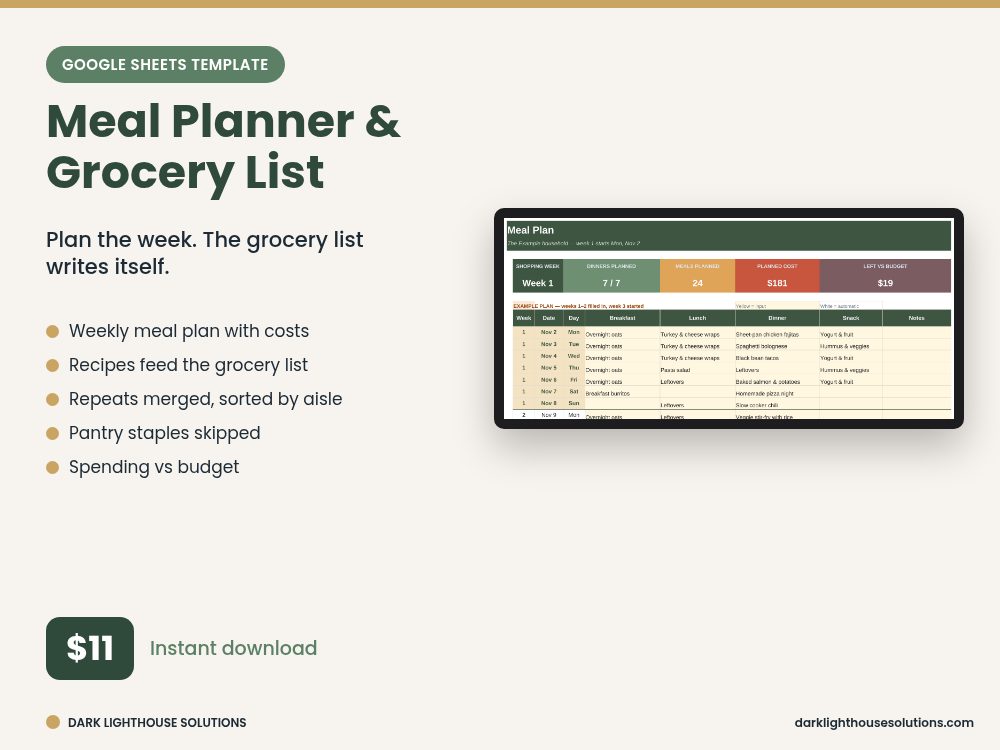
Meal Planner & Grocery List
Plan the week's meals and the grocery list writes itself: repeats merged, pantry staples skipped, sorted by aisle.
$11Buy now
Free tools › Grocery budget calculator
Add the people in your household and how many meals you make at home. See a realistic weekly and monthly grocery budget at four price levels, based on the USDA's latest food cost numbers. Free, no sign-up.
The Meal Planner turns the week's meals into a grocery list sorted by aisle, so you buy what you planned. The Monthly Budget Snapshot is free and puts groceries next to the rest of your money.
Plan the week's meals and the grocery list writes itself: repeats merged, pantry staples skipped, sorted by aisle.
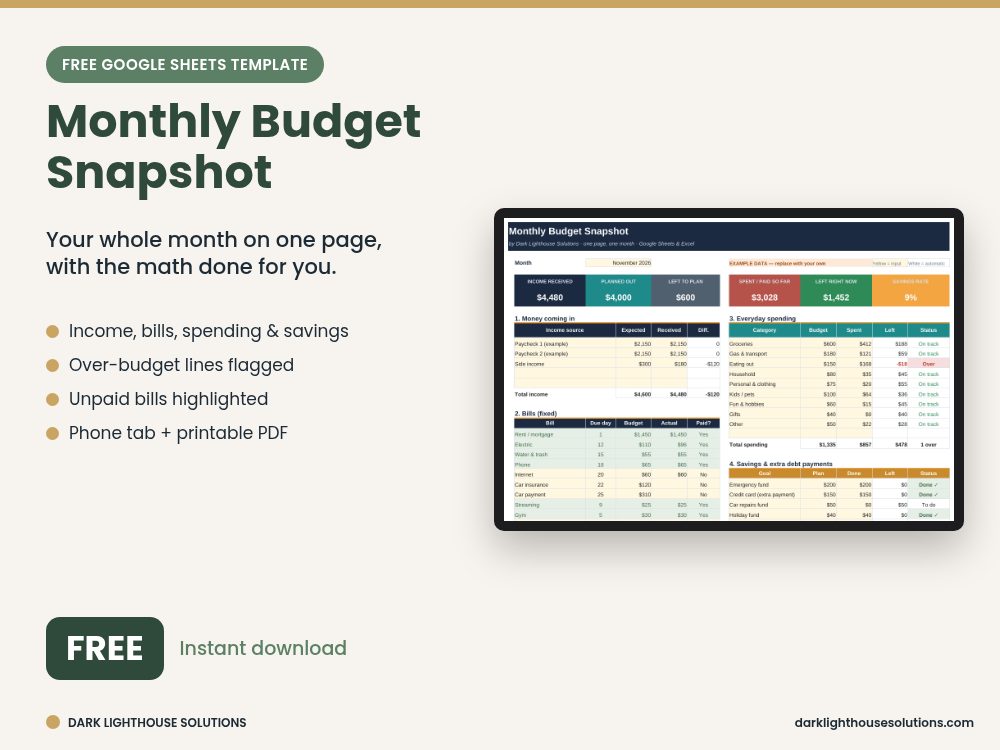
A free one-page monthly budget: income, bills, spending and savings, with over-budget and unpaid bills flagged.
Every month the U.S. Department of Agriculture publishes what it costs to eat a healthy diet at home at four price levels, called the USDA Food Plans. The costs are broken out by age and sex, because a 16-year-old boy eats a lot more than a 4-year-old. This calculator uses the September 2026 report. It adds up the cost for each person in your household, then applies USDA's own adjustment for household size: +20% for one person, +10% for two, +5% for three, none for four, −5% for five or six, and −10% for seven or more. Buying for one costs more per serving, and buying for a crowd costs less.
The numbers are U.S. averages for food you cook yourself. They don't include eating out, household supplies or alcohol, and they don't account for where you live. Use them as a benchmark, not a rule.
A quick example: a couple, both aged 20–50, cooking every meal at home. USDA's Moderate-cost plan comes to $398.40 + $336.40 = $734.80 a month. Add 10% for a two-person household and you get about $808 a month, or $186 a week. The Thrifty plan for the same couple is about $630 a month. If they eat five dinners out a week, the grocery number drops to roughly 16/21 of that, but the restaurant bill moves to another line of the budget.
The meal planner below does the planning part for you: you pick the week's meals and it builds the grocery list, merges repeats and skips what you already have. If you want to see groceries next to the rest of your money, the free Monthly Budget Snapshot is a one-page budget you can start today.
A fair benchmark is the USDA's food plans, which price a healthy diet made at home. For September 2026, the Thrifty plan for a woman aged 20–50 is about $254 a month and the Moderate-cost plan about $336, before the household-size adjustment. A single person adds 20% because buying for one costs more per serving. Enter your household above to get your own numbers.
Using the USDA's September 2026 numbers with the 20% single-person adjustment, a man aged 20–50 cooking every meal at home lands around $88 a week on the Thrifty plan and about $110 on the Moderate-cost plan. A woman of the same age lands around $70 and $93. Eating some meals out lowers your grocery number.
They're four USDA shopping lists that each meet nutrition guidelines at a different price. Thrifty is the cheapest. It's the one used to set SNAP benefits, and it takes a lot of cooking from scratch. Low-cost and Moderate-cost leave more room for convenience foods and brand names. Liberal is the most generous. None of them includes eating out.
These are U.S. averages. Prices are higher in big cities, Alaska and Hawaii, and lower in some regions. The USDA lists also cover food only, so they leave out paper towels, cleaning supplies, toiletries, pet food and alcohol, which many people buy on the same receipt. If you count those separately, the comparison is a lot fairer.
The USDA plans assume all 21 meals a week, plus snacks, come from your kitchen. If you eat 5 lunches at work or out, set this to 16 and the calculator scales the grocery estimate to 16/21 of the full amount. It's a straight-line estimate. Snacks and breakfasts tend to be cheaper than dinners, so treat it as a rough guide.